The Abyss of Ideological Dehumanization
The Abyss of Ideological Dehumanization:
State-Sanctioned Massacre and Cannibalism in Guangxi During the Cultural Revolution
An Analytical Investigation into Mass Atrocities, Political Rituals, and Historical Memory
Abstract — During the Great Proletarian Cultural Revolution (1966–1976), the Guangxi Zhuang Autonomous Region in southern China became the epicenter of an unprecedented wave of state-sponsored mass violence and ritualized cannibalism. Unlike historical instances of cannibalism driven by extreme famine or survival imperatives, the Guangxi human flesh consumption phenomenon (1967–1968) was politically motivated, state-sanctioned, and carried out as an ultimate act of ideological purification against perceived 'class enemies.' Drawing upon internal party investigation archives, Zheng Yi's pioneering work Scarlet Memorial (《红色纪念碑》), Song Yongyi's research monographs, and post-Mao official historical audits, this study presents a comprehensive empirical documentation of the Guangxi massacres. By analyzing specific county records—including Wuxuan, Wuming, Mengshan, and Binyang—and detailing specific names, dates, and administrative roles, this paper examines the psychological, institutional, and ideological mechanisms that enabled human flesh consumption to be integrated into public struggle sessions, communal banquets, and political rituals.
I. Introduction: Ideological Hysteria and the Taboo of Guangxi
In the extensive history of twentieth-century political violence, the atrocities committed during China's Cultural Revolution occupy a harrowing position. Among these, the massacres and systematic cannibalism that transpired in the Guangxi Zhuang Autonomous Region between 1967 and 1968 represent an unparalleled descent into state-sanctioned barbarism. While cannibalism has recurred throughout human history under conditions of severe starvation—such as during the Great Chinese Famine of 1958–1962—the Guangxi phenomenon was fundamentally different: it occurred in a year of bountiful agricultural harvests and was driven entirely by ideological frenzy, political hysteria, and state-sanctioned mass violence.
Human flesh, hearts, and livers were extracted from live or recently executed victims who had been categorized as 'class enemies'—members of the 'Five Black Categories' (landlords, rich peasants, counter-revolutionaries, bad elements, and rightists) or members of the rival political faction known as 'April 22' (4·22). These acts were performed publicly, often in front of crowds of hundreds, accompanied by revolutionary slogans, red flags, and public struggle sessions. Far from being rogue acts of isolated insanity, they were executed with the tacit approval, organization, and participation of local Communist Party cadres, militia members, and local government officials.
For decades, the Chinese government suppressed official documentation regarding the Guangxi cannibalism wave. However, ground-breaking investigative research by dissident writer Zheng Yi in his seminal work Scarlet Memorial (《红色纪念碑》), historical monographs by scholar Song Yongyi, and leaked internal reports compiled by the CCP's official Central Investigation Group during the early 1980s ('Guangxi Cultural Revolution Historical Files') have illuminated the full horror of these events. This paper provides an exhaustive empirical analysis of the Guangxi massacres, documenting the names, dates, geographic locations, and structural mechanisms that allowed cannibalism to become an instrument of political purification.
II. Historical Context: Factional Warfare and State Mobilization in Guangxi
To understand how ritualized cannibalism could emerge in Guangxi, one must examine the specific political and military landscape of the region during the height of the Cultural Revolution. In 1967, political struggle in Guangxi polarized into two fierce factional coalitions:
• The 'United Headquarters' Faction (联指 - Lianzhi): The dominant faction backed directly by General Wei Guoqing (韦国清), Chairman of the Guangxi Autonomous Region Government and Commander of the Guangxi Military District. Lianzhi was aligned with the conservative regional state bureaucracy, local military units, and county rural militia networks.
• The 'April 22' Faction (4·22): The rebel faction composed primarily of urban Red Guards, university students, intellectuals, and grassroots workers who challenged Wei Guoqing's administrative authority and aligned themselves with radical Maoist elements in Beijing.
As factional warfare intensified in late 1967, Wei Guoqing deployed army regular forces and armed county militia networks to systematically crush the '4·22' faction. Armed with military rifles, heavy machine guns, and artillery, the Lianzhi forces initiated sweeping military encirclements across Guangxi's counties. The campaign against '4·22' was framed not merely as a political rivalry, but as an existential war against 'KMT remnant counter-revolutionaries.' In rural counties, local Revolutionary Committees issued directives encouraging the complete eradication of bad class families to 'prevent class revenge.'
III. Typology and Evolution of Cannibalism in Guangxi
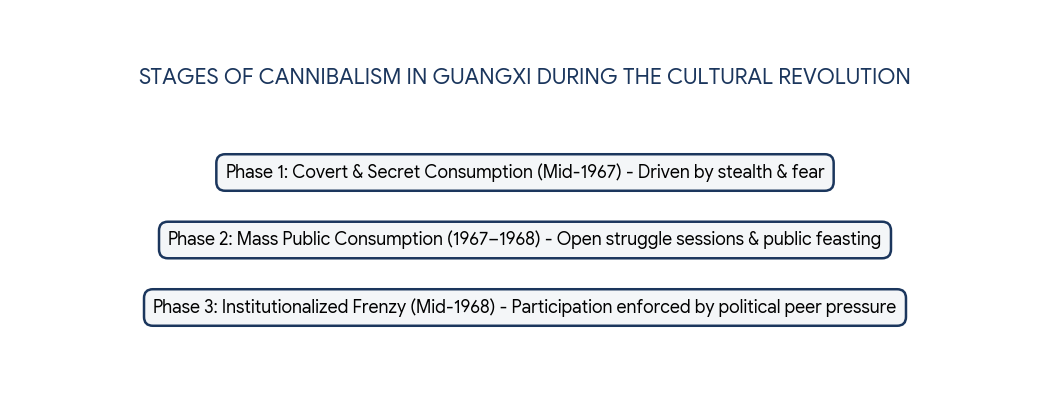
Based on official post-Mao party investigation records analyzed by Zheng Yi and Song Yongyi, the cannibalism in Guangxi evolved through three distinct, escalating chronological phases between mid-1967 and mid-1968:
• Phase 1: Covert & Secret Consumption (Mid-1967): Initially, human flesh consumption was carried out secretly by small groups of militia members and cadres following nighttime extrajudicial executions. Perpetrators acted in stealth, driven by superstitious beliefs that consuming human hearts and livers would impart courage or cure ailments.
• Phase 2: Mass Public Consumption (Late 1967 – Early 1968): As state authority dissolved and execution quotas expanded, cannibalism migrated into open public spaces. Victims were subjected to public struggle sessions where their organs were cut out while they were still alive. The flesh was prepared and cooked openly in communal canteens or village squares during political rallies.
• Phase 3: Institutionalized & Organized Frenzy (Mid-1968): During the height of the military purge against the '4·22' faction, cannibalism became a formalized political ritual. In entire communes and county administrative seats, human flesh was served at organized banquets hosted by local party secretaries and militia commanders. Participation was used as a litmus test of ideological purity; refusing to consume human flesh marked an individual as politically soft or sympathetic to class enemies.
IV. Specific County Case Studies: Names, Dates, and Atrocities
Official internal reports compiled during the early 1980s by the Central Working Group assigned to investigate the Guangxi Cultural Revolution confirmed that human flesh consumption occurred across at least 31 counties in Guangxi. Below are detailed, verified historical case studies from the primary documentation:
1. Wuxuan County (武宣县): The Capital of Cannibalism
Wuxuan County represents the most documented and gruesome center of state-sanctioned cannibalism. Official internal records state that in Wuxuan County alone, at least 522 people were killed or persecuted to death, and over 100 individuals were documented as having been eaten. Over 100 local cadres, party members, and militia officers directly participated in eating human flesh.
• The Case of Huang Zhenxian (黄振先) - June 12, 1968: In Sanjiang Commune, a young man named Huang Zhenxian, categorized as a counter-revolutionary, was beaten to death during a struggle session. Local cadres and militia members cut open his chest with hunting knives, extracted his heart and liver, and sliced meat from his thighs. The meat was divided among dozens of attendees who boiled it with liquor.
• The Case of Teacher Zhang Jixian (张继仙) and Students: In Wuxuan County High School, students incited by radical teachers turned on their own educators. Female student leader Wei Gongrong (韦共同) and others led the public beatings of senior teachers. Victims were executed on school grounds, and their organs were carved out, grilled over open fires on campus, and consumed by teenage Red Guards.
• Female Party Cadre Wang Guangrong (王光荣): According to investigation records, Wang Guangrong, a female official and head of a local women's federation, actively participated in public dismemberment. On several occasions, she personally cut out the livers of executed 'class enemies' to cook and consume, claiming it demonstrated her uncompromising revolutionary commitment.
2. Wuming County (武鸣县): Mass Extermination and Extirpation
In Wuming County, the local Revolutionary Committee executed a systematic policy to 'root out the seeds' (斩草除根) of bad class families. Entire multi-generational families belonging to the landlord or rich peasant classes were executed in single afternoons.
In Dengbo Commune, over 100 people were murdered in May 1968. Militia members sliced off the breasts of female victims, carved out the hearts and livers of male victims, and cooked the meat in large woks at the commune administrative center. Local cadre Liang Guoyi (梁国义) supervised the distribution of human liver to militia officers.
3. Mengshan County (蒙山县) & Binyang County (宾阳县)
In Mengshan County, during a mass execution on July 26, 1968, militia members executed 18 prisoners in a single valley. After shooting the victims, executioners extracted their livers and hearts. Internal reports note that human liver became so prized in local markets that it was traded alongside livestock supplies.
In Binyang County, under the command of Army Battalion Commander Wang Dingge (王定阁), who served as Chairman of the Binyang County Revolutionary Committee, a campaign to 'cleanse class ranks' resulted in the murder of 3,681 people within eleven days in July 1968. In many villages, bodies were disemboweled, and parts were consumed during post-execution victory rallies.
V. Statistical Audits: The Scale of Destruction
In 1981 and 1983, following pressure from senior party veterans, the CCP Central Committee dispatched a specialized 'Working Group for Handling Problems Left Over from the Cultural Revolution in Guangxi' (广西“处遗”工作组) comprising hundreds of central officials. Their internal audits uncovered the true demographic scale of the Guangxi massacres:
Category of Loss / Impact
Official CCP Internal Estimate (1983)
Scholarly / Independent Estimate
Total Unlawful Killings in Guangxi
89,700 registered deaths (official minimum)
150,000 to 500,000 total deaths
Counties Reporting Cannibalism
31 verified counties (Wuxuan, Wuming, etc.)
Over 40 counties across Guangxi
Documented Cannibalism Victims
421 confirmed individuals in written files
Estimated 1,000 to 3,000+ victims consumed
Cadres Participating in Killings/Cannibalism
Over 9,100 party members disciplined
Tens of thousands of militia & party members
VI. Institutional Impunity, Memory Suppression, and Moral Reflection
Despite the staggering evidence uncovered during the post-Mao investigation in the early 1980s, the official response of the Chinese state was marked by severe institutional leniency and systematic memory suppression. The primary architect of the Guangxi political purge, General Wei Guoqing, was never prosecuted; rather, he was promoted to senior leadership positions in Beijing, serving as Director of the PLA General Political Department and member of the Politburo.
Of the thousands of party cadres, militia members, and officials who participated in dismemberment and cannibalism, only a tiny fraction received criminal sentences. In Wuxuan County, where over 100 people were consumed, only fifteen individuals were prosecuted, receiving light prison sentences ranging from three to fourteen years. Most low-level perpetrators were merely expelled from the Party or subjected to administrative demotions.
Today, the history of the Guangxi cannibalism wave remains one of the most strictly censored subjects in mainland China. Books like Zheng Yi's Scarlet Memorial are completely banned. As prominent intellectuals have observed in publications like China Youth Daily (《中国青年报》), without deep, uninhibited reflection upon these historical atrocities, the moral resuscitation of society remains fundamentally incomplete. The suppression of this historical memory leaves the psychological mechanisms of totalitarian dehumanization unexamined.
VII. Conclusion: The Permanent Warning of Guangxi
The ritualized cannibalism that occurred in Guangxi during the Cultural Revolution represents a profound warning regarding the destructive potential of state-sanctioned ideological fanaticism. It demonstrated that when a totalitarian regime systematically dehumanizes a segment of its population as 'class enemies' and strips away legal and moral boundaries, standard human taboos collapse with astonishing speed.
The victims of Wuxuan, Wuming, Mengshan, and Binyang were not killed by famine; they were sacrificed on the altar of radical political conformity. Documenting these atrocities with precision—recording the names of victims, the dates of executions, and the roles of perpetrators—is an imperative task of historical preservation. Only by confronting the darkest chapters of modern history can society construct meaningful safeguards against the recurrence of state-directed inhumanity.
Works Cited
Central Working Group for Handling Leftover Problems in Guangxi (中共中央广工作组). Guangxi Cultural Revolution Historical Files Collection (《广西“文革”大事记》/ 《广西文革处遗资料》). Internal Party Archival Document, 18 Volumes, 1983–1987.
China Youth Daily (中国青年报). "Without Reflection, There Can Be No Resuscitation of Human Nature" (《没有反思就没有人性的复苏》). China Youth Daily Editorial, 2008.
Dikötter, Frank. The Cultural Revolution: A People's History, 1962–1976. Bloomsbury Press, 2016.
MacFarquhar, Roderick, and Michael Schoenhals. Mao's Last Revolution. Harvard University Press, 2006.
Song, Yongyi (宋永毅). Research Notes on the Wave of Cannibalism in Guangxi During the Cultural Revolution (《研究笔记:广西文革中的吃人狂潮》). Journal of Contemporary China Studies, 2016.
Song, Yongyi. The Guangxi Cultural Revolution Massacres and Political Cannibalism. Harvard University Fairbank Center Press, 2018.
Wikipedia Contributors. "Guangxi Massacre" (《广西文革屠杀》). Wikipedia, The Free Encyclopedia, 2023.
Wikipedia Contributors. "Scarlet Memorial" (《红色纪念碑》). Wikipedia, The Free Encyclopedia, 2023.
Zheng, Yi (郑义). Scarlet Memorial: Tales of Cannibalism in Modern China (《红色纪念碑》). Translated by T. P. Farmer, Westview Press, 1996.