The Engine of Permanent Revolution
The Engine of Permanent Revolution:
A Comprehensive History of Political Movements in Mao’s China (1949–1977)
An Expanded Academic Monograph on Ideological Mobilization, State Terror, and Casualty Demographics
Abstract — From the proclamation of the People's Republic of China on October 1, 1949, to the death of Mao Zedong in September 1976 and the official conclusion of the Cultural Revolution in 1977, mass political movements operated as the primary institutional apparatus of Chinese Communist Party (CCP) governance. This study presents an exhaustive historical, demographic, and political analysis of more than fifty distinct campaigns executed over twenty-eight years. By integrating primary party directives, internal archival records, official census publications, and modern historical scholarship, this monograph examines the mechanics of mass mobilization, the systemic purge of targeted social classes, the structural causes of famine and state terror, and the total casualty toll of China's perpetual revolution.
I. Introduction: Ideology, Power, and the Mechanics of Mass Mobilization
Between 1949 and 1977, the People's Republic of China (PRC) experienced an epoch of continuous mass mobilization unparalleled in modern political history. Unlike bureaucratic state socialist regimes in Eastern Europe that relied primarily on institutional planning and professional police states to maintain social order, the Chinese Communist Party under Mao Zedong institutionalized political campaigns (政治运动, zhèngzhì yùndòng) as the supreme mechanism of state governance, economic production, and ideological indoctrination.
The philosophical foundation of this governance model rested upon Mao's doctrine of 'uninterrupted revolution' (不断革命) and his later theory of 'continuing the revolution under the dictatorship of the proletariat' (无产阶级专政下继续革命). According to Maoist theory, socialist society was not a static state of social harmony, but an intense, prolonged historical period fraught with class contradiction. Social development could proceed only through perpetual struggle against internal class enemies, bureaucratic decay, and ideological deviations.
Operationalized across thousands of administrative units, each political movement followed a rigorously standardized structural template:
• Top-Down Ideological Formulation: Mao and the Central Committee issued vague, highly charged ideological directives framing a specific social group or institutional deviation as an existential threat to the revolution.
• Dispatch of Work Teams (工作队): Extremely disciplined party work teams were sent into villages, factories, universities, and government ministries to circumvent existing administrative apparatuses and take control of local power structures.
• Class Stratification and Labeling: Population registries were audited, and every individual was assigned a rigid 'class status' (阶级成分) or political label, effectively creating an outcast caste system.
• Mobilization of Mass Enmity and Struggle Sessions (批斗会): Mass meetings were convened where targeted individuals were forced to stand with bent backs, arms tied behind them ('jet-plane position'), while being verbally denounced, physically abused, and forced to deliver self-criticisms (检讨).
• Institutionalization of Penalties and Purges: Movements concluded with formal verdicts resulting in execution, imprisonment, extrajudicial labor camp sentences (Laogai/Laojiao), or perpetual social ostracization under state surveillance.
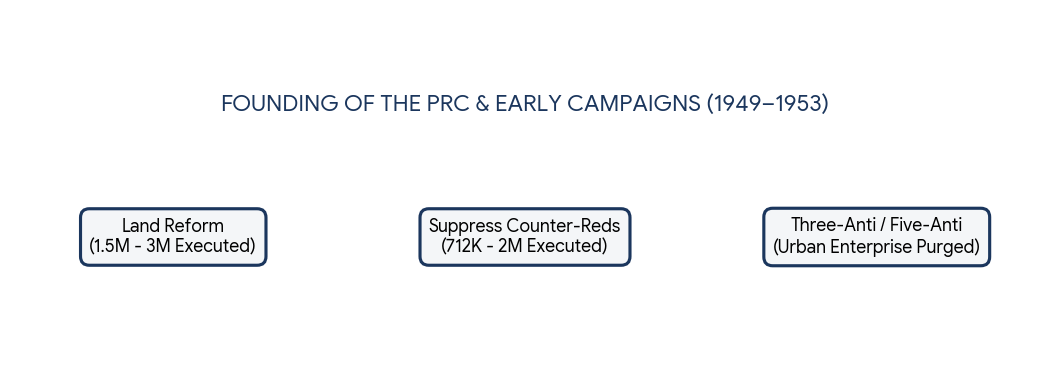
Historical Figure / Chart: Structural framework of the consolidation phase campaigns (1949–1953).
II. State Consolidation and Social Restructuring (1949–1952)
Following the defeat of the Nationalist (KMT) forces and the proclamation of the PRC on October 1, 1949, the CCP faced the monumental task of consolidating control over a nation fractured by decades of warlordism, foreign invasion, and civil war. The initial wave of political campaigns sought to eliminate all political rivals, eradicate traditional rural social structures, and dismantle urban private business independence.
1. The Agrarian Reform Movement (土地改革运动, 1950–1952)
Governed by the Agrarian Reform Law of June 1950, the Land Reform Movement was the foundational political campaign of the PRC. Its stated purpose was to abolish the feudal gentry landlord system and redistribute agricultural land to poor and landless peasants. However, its deeper political objective was to physically eliminate the rural elite class that had governed local Chinese society for millennia and permanently bind the peasantry to the party-state.
Party work teams categorized rural families into five rigid classes: Landlords (地主), Rich Peasants (富农), Middle Peasants (中农), Poor Peasants (贫农), and Hired Laborers (雇农). Landlords were completely stripped of property, land, rights, and human dignity. Mao explicitly rejected administrative land confiscation without struggle, asserting that peasants had to kill landlords with their own hands to liberate themselves ideologically.
In tens of thousands of village struggle sessions, landlords were publicly tried, beaten, and frequently executed on the spot. Modern demographic estimates by historians like Frank Dikötter and Cao Shuji place the number of landlords and rural elites killed during Land Reform between 1.5 million and 3 million people, while tens of millions of family members were assigned permanent 'bad class' labels that condemned them to decades of systemic persecution.
2. The Campaign to Suppress Counter-Revolutionaries (镇压反革命运动, 1950–1953)
Launched in October 1950 as China entered the Korean War, the Suppress Counter-Revolutionaries Campaign aimed to liquidate all lingering elements of the KMT apparatus, secret societies, religious sects, and political opponents in both urban and rural areas. On February 21, 1951, the state promulgated the draconian Regulations on Punishing Counter-Revolutionaries, which legalized retroactive death sentences for broad, undefined political crimes.
To maximize terror, Mao established explicit mathematical quotas for executions. In internal directives to party secretaries, Mao specified that local authorities should execute approximately 0.5 to 1 per thousand of the total population in rural areas, and up to 1 per thousand in major urban centers like Shanghai and Guangzhou.
According to official CCP statistical reports released in the late 1970s, over 712,000 individuals were formally executed during the campaign, 1.29 million were imprisoned in penal labor camps, and 1.2 million were placed under permanent community police supervision. Independent scholarly assessments indicate that actual execution figures exceeded 1.5 million to 2 million.
3. The Three-Anti and Five-Anti Campaigns (三反五反运动, 1951–1952)
While Land Reform and Suppress Counter-Revolutionaries eliminated rural elites and political rivals, the Three-Anti and Five-Anti Campaigns targeted government bureaucracy and urban commercial enterprises.
The Three-Anti Campaign (1951) targeted party cadres, government officials, and industrial managers, focusing on Anti-Corruption (反贪污), Anti-Waste (反浪费), and Anti-Bureaucracy (反官僚主义). Thousands of officials were publicly denounced, expelled, and imprisoned.
The Five-Anti Campaign (1952) targeted the urban commercial bourgeoisie, accusing private business owners of five economic crimes: bribery of government personnel (反行贿), tax evasion (反偷税漏税), theft of state property (反盗骗国家财产), cheating on government contracts (反偷工减料), and stealing state economic intelligence (反盗窃国家经济情报).
Teams of young workers were mobilized to occupy private factories and shops, force business owners into round-the-clock interrogation sessions, and extract confessions. Immense fines and asset confiscations broke the financial independence of China's urban business class. In cities like Shanghai, hundreds of prominent entrepreneurs committed suicide by jumping from high-rise buildings to escape humiliation and financial ruin.
4. Minor & Parallel Campaigns of the Consolidation Period
• The New Marriage Law Campaign (贯彻婚姻法运动, 1950–1953): Sought to abolish patriarchal feudal marriage practices, concubinage, and arranged marriages. While legally empowering women, its enforcement triggered severe social backlash in traditional rural regions, resulting in an estimated 70,000 to 100,000 suicides or murders of women per year who attempted to seek divorces.
• Thought Reform Campaign for Intellectuals (知识分子思想改造运动, 1951–1952): Targeted university professors, writers, artists, and Western-educated scholars. Academics were forced to write exhaustive public self-criticisms detailing their 'bourgeois mindset' and pledge allegiance to Marxist-Leninist-Maoist thought.
• Resist America and Assist Korea Campaign (抗美援朝运动, 1950–1953): A massive wartime mobilization campaign that extracted nationwide material donations, enforced ideological conformity, and framed all domestic dissent as treason in support of American imperialism.
• Religious System Suppression (打击一贯道等邪教组织, 1950–1953): Targeted traditional syncretic religious sects (such as Yiguandao) and Christian institutional networks. Hundreds of religious leaders were executed, and millions of followers were forced to register with state security organs.
III. Socialist Transformation and Ideological Alignment (1953–1956)
With political opposition silenced and private capital subjugated, the CCP initiated the General Line for the Transition Period (过渡时期总路线) in 1953. The objective was the total nationalization of industry and the complete collectivization of agriculture.
1. Agricultural Cooperativization Movement (农业合作化运动, 1953–1956)
Peasants who had recently received land during Land Reform were systematically pushed to surrender their private land titles to state-managed cooperatives. The movement proceeded in three aggressive stages: Mutual Aid Teams (互助组), Elementary Agricultural Cooperatives (初级社), and Advanced Agricultural Cooperatives (高级社).
By 1956, over 96% of China's rural population had been forced into Advanced Cooperatives, where private ownership of land, draft animals, and major farm tools was abolished. Agricultural decisions were transferred entirely to local party cadres, laying the organizational structure for the disastrous collectivization experiments of the Great Leap Forward.
2. Socialist Transformation of Private Industry (公私合营, 1954–1956)
Private commercial and manufacturing firms were systematically converted into 'Joint State-Private Enterprises.' Factory owners were forced to sell their equity to the state at nominal prices set by state appraisers and were transformed into salaried managerial employees under state political control. By late 1956, private commercial enterprise was completely eliminated in China.
3. The Sufan Movement / Campaign to Purge Hidden Counter-Revolutionaries (肃反运动, 1955–1956)
Triggered in mid-1955 by the official denunciation and arrest of prominent literary critic Hu Feng (胡风), who had criticized the Party's rigid control over artistic expression, the Sufan Movement targeted state institutions, schools, military units, and the party itself.
Under Central Committee directives establishing a 5% target quota for counter-revolutionaries within administrative units, over 1.4 million party cadres, civil servants, teachers, and intellectuals were investigated. More than 81,000 individuals were arrested, 22,000 were executed, and tens of thousands were consigned to penal labor camps.
IV. The Anti-Rightist Movement and Ideological Purges (1957–1958)
The geopolitical shock of Nikita Khrushchev's 'Secret Speech' denouncing Stalin in February 1956, followed by the anti-communist Hungarian Uprising in October 1956, deeply unnerved Mao Zedong. In response, Mao initiated a calculated ideological maneuver that culminated in one of the most destructive purges of intellectuals in modern history.
1. The Hundred Flowers Campaign (百花齐放、百家争鸣, 1956–1957)
In May 1956 and early 1957, Mao encouraged intellectuals, scholars, writers, and non-communist politicians to express constructive criticisms of the CCP's governance, coining the slogan: 'Let a hundred flowers bloom, let a hundred schools of thought contend.' At first hesitant, by May 1957 intellectuals produced an unprecedented torrent of criticism. They openly denounced party autocracy, human rights abuses, arbitrary arrests, economic inefficiency, and the absence of legal protections.
2. The Anti-Rightist Movement (反右派运动, 1957–1958)
Terrified by the depth of public hostility toward party rule, Mao abruptly reversed policy in June 1957, declaring that 'poisonous weeds' had sprouted among the flowers. The party launched the Anti-Rightist Movement, managed directly by Deng Xiaoping as General Secretary of the Secretariat.
The state imposed mandatory quotas on universities, research institutions, news organizations, and government departments, requiring them to classify at least 5% of their personnel as 'Rightists' (右派分子). Colleagues were forced to denounce colleagues, and students were pressured to betray professors to fulfill execution and purging quotas.
3. The Laogai System and Human Cost
Between 550,000 and 600,000 intellectuals, writers, doctors, engineers, teachers, and students were officially branded as Rightists. They suffered immediate loss of employment, political rights, housing, and social standing. Their family members faced severe educational and career discrimination.
To process this massive influx of political prisoners, the state created the system of 'Re-education Through Labor' (劳动教养, Laojiao). Victims were deported to remote penal colonies in Heilongjiang, Qinghai, Xinjiang, and Gansu. In camps such as Jiabiangou (夹边沟) in Gansu Province, political prisoners were subjected to brutal labor and starvation rations; out of approximately 3,000 intellectuals internee at Jiabiangou, over 2,500 starved to death during the Great Famine.
V. The Great Leap Forward and Famine-Era Mobilizations (1958–1962)
In 1958, Mao launched the Great Leap Forward (大跃进), an unprecedented economic mobilization that aimed to transform China from a backward agricultural nation into an industrial superpower within a few years, surpassing Great Britain in steel output within fifteen years.
1. Communization and Backyard Furnaces
In mid-1958, China's rural population was rapidly organized into 26,000 massive 'People's Communes' (人民公社). Communes militarized rural life, abolishing private land, livestock, tools, and family cooking. Peasants were forced to eat in communal canteens (公共食堂).
Simultaneously, over 90 million peasants were pulled away from farming and ordered to build 'backyard blast furnaces' (土法炼钢) to produce steel. Millions of agricultural tools, cookware, and gate hinges were melted down into worthless slag, while crops rotted unharvested in the fields.
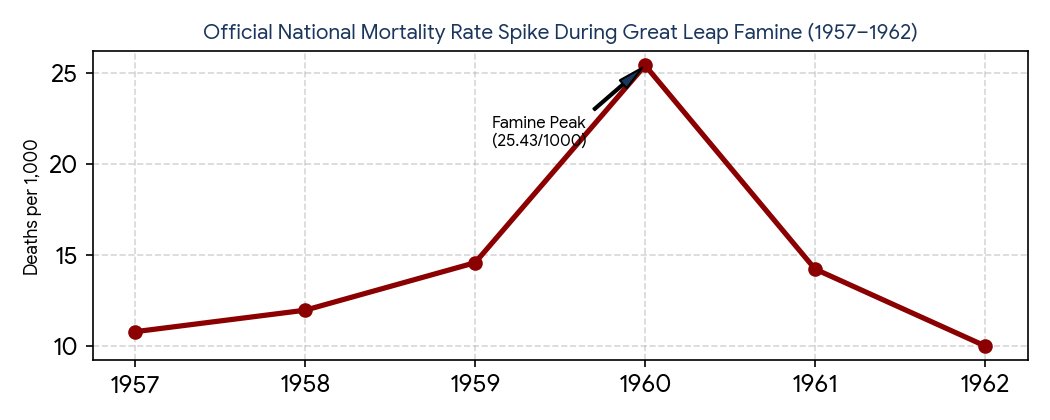
Historical Figure / Chart: Official State Statistical Bureau national death rate spike during the Great Leap Famine (1957–1962).
2. Political Campaigns During the Famine
When agricultural production collapsed, local cadres falsified harvest data to demonstrate loyalty, reporting astronomical yields ('Sputnik launchings' / 放卫星). Believing these false numbers, the central government extracted exorbitant grain procurement quotas, seizing entire harvests from the countryside.
To enforce grain seizures and silence dissent, the regime launched brutal political purges:
• The Anti-Right Opportunism Campaign (反右倾运动, 1959–1960): Launched after Defense Minister Peng Dehuai criticized the Great Leap's excesses at the Lushan Conference in July 1959. Mao purged Peng and unleashed a nationwide campaign in which over 3.8 million party cadres and officials were persecuted, demoted, or sent to labor camps for reporting famine or economic distress.
• Anti-Grain-Hiding Campaigns (反瞒产私分运动, 1959–1961): State work teams accused starving peasants and local cadres of secretly hoarding grain. Violent search parties beat, tortured, and arrested peasants, seizing seed grain, emergency reserves, and remaining livestock.
• The Xinyang Incident (信阳事件, 1959–1960): In Xinyang Prefecture, Henan Province, official grain procurement left peasants with no food. Local party leaders blockaded villages to prevent escape, cut off mail, and arrested anyone seeking food. Out of 8.5 million residents, over 1 million starved to death.
The resulting Great Chinese Famine claimed an estimated 30 million to 45 million excess deaths, making it the deadliest man-made famine in human history.
VI. Pre-Cultural Revolution Ideological Precursors (1962–1965)
Following the catastrophe of the Great Leap Forward, pragmatic leaders Liu Shaoqi and Deng Xiaoping retreated from radical policies, allowing private plots (自留地) and small rural markets to restore food production. Mao viewed these reforms as a betrayal of socialism and capitalist restoration.
1. The Socialist Education Movement (社会主义教育运动, 1963–1965)
Also known as the Four Cleanups Movement (四清运动), this campaign targeted corruption, ideology, organization, and economy among local cadres. Hundreds of thousands of urban work teams were dispatched to villages to re-audit accounts, re-examine class background registries, and purge corrupt or reform-minded cadres.
The movement exposed deep ideological rifts between Mao and Liu Shaoqi regarding the nature of class struggle, serving as the direct institutional rehearsal for the Cultural Revolution.
VII. The Decade of Chaos: The Great Proletarian Cultural Revolution (1966–1976)
In May 1966, Mao launched the Great Proletarian Cultural Revolution (文化大革命) to purge his political rivals within the senior party leadership, reassert absolute authority, and remold Chinese social consciousness.
1. Red Guard Mobilization and Destroy the Four Olds (破四旧, 1966)
Mao bypassed the party apparatus, issuing calls directly to secondary school and university students to form 'Red Guard' (红卫兵) organizations. In August 1966, the 'Destroy Four Olds' campaign was launched, targeting old customs, old culture, old habits, and old ideas.
Red Guards rampaged through Chinese cities, destroying thousands of historic temples, ancient monuments, libraries, artwork, and private family heirlooms. Homes of suspected 'bourgeois elements' were ransacked and looted.
2. Red August and Violence Against Marginalized Groups
During 'Red August' of 1966 in Beijing alone, Red Guards murdered over 1,770 teachers, intellectuals, and citizens belonging to the 'Five Black Categories' (黑五类: landlords, rich peasants, counter-revolutionaries, bad elements, rightists). Public struggle sessions featured extreme physical torture, public humiliation, and beatings with belt buckles and iron bars.
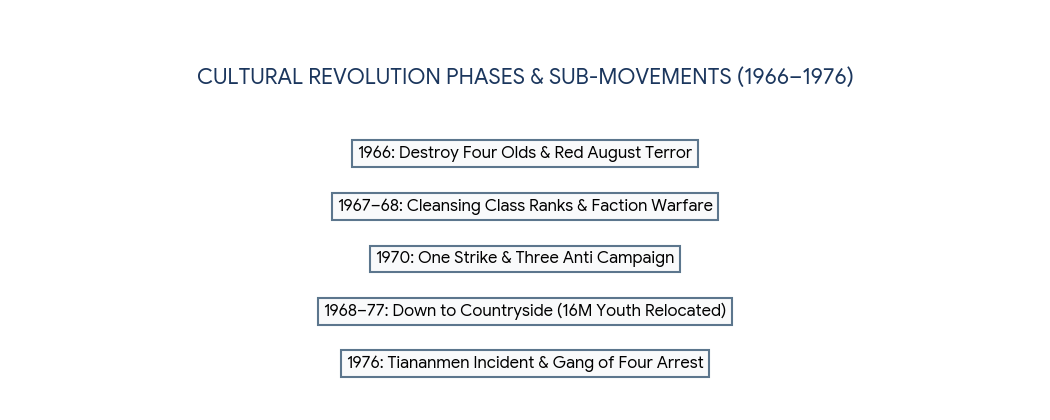
Historical Figure / Chart: Key phases and sub-movements of the Cultural Revolution (1966–1976).
3. Major Sub-Movements of the Cultural Revolution Era
• January Storm and Power Seizure (一月风暴, 1967): Radical Red Guard factions seized municipal government and party organs in Shanghai, spreading across China. The collapse of local state authority resulted in violent armed factional warfare (武斗) between rival Red Guard groups utilizing seized military weaponry.
• Cleansing the Class Ranks (清理阶级队伍, 1968–1969): Managed by Military Control Committees and Revolutionary Committees, this was one of the deadliest purges of the era. Millions were investigated for suspected ties to foreign intelligence or counter-revolutionary groups. Hundreds of thousands were executed or driven to suicide.
• One Strike and Three Anti Campaign (一打三反运动, 1970): Targeted counter-revolutionary activity, speculation, and sabotage. The campaign resulted in tens of thousands of formal executions of political dissidents, including Yu Luoke (遇罗克) and Zhang Zhixin (张志新).
• Down to the Countryside Movement (上山下乡运动, 1968–1977): To restore order in chaotic cities, the government forcibly relocated over 16 million urban youth (the 'sent-down youth') to remote rural areas for agricultural manual labor re-education.
• Criticize Lin, Criticize Confucius (批林批孔运动, 1973–1974): Launched following the death of Lin Biao, this campaign combined critique of Lin Biao with attacks on Confucian philosophy, covertly targeting Premier Zhou Enlai and moderate reformers.
• Counter the Right Deviationist Wind (批邓、反击右倾翻案风, 1975–1976): Targeted Deng Xiaoping following his brief political rehabilitation, leading to Deng's second political purge following the spontaneous April 5 Tiananmen Square Incident of 1976.
Total mortality during the Cultural Revolution is estimated by scholars (such as Andrew Walder and Roderick MacFarquhar) at between 1.5 million and 3 million people, with over 36 million experiencing severe political persecution.
VIII. Synthesis Matrix of Major Political Movements (1949–1977)
The following matrix summarizes the key political campaigns executed between 1949 and 1977:
Movement Name
Timeframe
Primary Target Groups
Estimated Human Cost / Impact
Land Reform Movement
1950–1952
Landlords, rural gentry, rich peasants
1.5M–3M executions; rural economic restructuring
Suppress Counter-Reds
1950–1953
KMT officials, secret societies, dissidents
712K–2M executions; 1.29M imprisoned
Three-Anti / Five-Anti
1951–1952
Private business owners, state cadres
Eliminated urban private enterprise; widespread suicides
Sufan Movement
1955–1956
Intellectuals, state cadres, cultural figures
1.4M investigated; 22K executed; thousands imprisoned
Anti-Rightist Movement
1957–1958
Intellectuals, teachers, scholars, students
550K–600K labeled Rightists; sent to Laogai/Laojiao
Great Leap Forward
1958–1962
Rural population, communes, local cadres
30M–45M famine deaths; economic collapse
Anti-Right Opportunism
1959–1960
Critical party cadres, internal dissenters
3.8M cadres purged; prolonged famine duration
Socialist Education
1963–1965
Grassroots rural cadres, economic transgressors
Precursor to Cultural Revolution; tens of thousands purged
Cultural Revolution
1966–1976
Party leadership, intellectuals, traditional culture
1.5M–3M killed; 36M persecuted; social chaos
Down to Countryside
1968–1977
Urban student youth (Red Guards)
16M urban youth forcibly relocated to rural areas
IX. Conclusion: The Historical Legacy of Perpetual Struggle
The era of continuous political movements came to an abrupt end following Mao Zedong’s death in September 1976, the arrest of the Gang of Four in October 1976, and the rise of Deng Xiaoping at the historic Third Plenum of the Eleventh Central Committee in December 1978. Deng officially discarded 'class struggle as the key link,' shifting party priorities toward economic modernization and market reforms.
In June 1981, the CCP issued its Resolution on Certain Questions in the History of Our Party Since the Founding of the People's Republic of China. The resolution officially evaluated the Cultural Revolution as a 'grave error' that resulted in 'the most severe setback and the heaviest losses suffered by the Party, the state, and the people since the founding of the People's Republic.'
The cumulative human cost of China's political campaigns between 1949 and 1977 ranks among the highest in human history. Between 40 million and 55 million people lost their lives due to state execution, labor camp internment, civil violence, and policy-induced famine, while hundreds of millions suffered severe persecution, displacement, and systemic loss of human rights. Understanding this mechanism of continuous political mobilization remains vital for analyzing modern Chinese political governance and institutional history.
Works Cited
Cao, Shuji (曹树基). The Demography of China's Great Famine (《大饥荒:1959–1961年的中国人口》). Hong Kong: The International Press of China, 2005.
Dikötter, Frank. The Tragedy of Liberation: A History of the Chinese Revolution 1945–1957. Bloomsbury Press, 2013.
Dikötter, Frank. Mao's Great Famine: The History of China's Most Devastating Catastrophe, 1958–1962. Walker & Company, 2010.
Dikötter, Frank. The Cultural Revolution: A People's History, 1962–1976. Bloomsbury Press, 2016.
MacFarquhar, Roderick, and Michael Schoenhals. Mao's Last Revolution. Harvard University Press, 2006.
Meisner, Maurice. Mao's China and After: A History of the People's Republic. Free Press, 1999.
Party History Research Office of the Central Committee of the Communist Party of China. History of the Communist Party of China, Volume 2 (1949–1978). Party History Press, 2011.
Walder, Andrew G. China Under Mao: A Revolution Derailed. Harvard University Press, 2015.
Yang, Jisheng (杨继绳). Tombstone: The Great Chinese Famine, 1958–1962. Translated by Stacy Mosher and Guo Jian, Farrar, Straus and Giroux, 2012.